Thanks for visiting my website!



Micro Course:
Email Marketing That Actually Works
Who this is for: Beginners and low-intermediate online marketers who know they "should be doing email" but feel overwhelmed by tools, jargon, and conflicting advice. By the end of this micro course, you will have picked a platform, built a simple welcome sequence, and know exactly which three numbers to watch.
Time to complete: About 60-90 minutes, or one lesson per day for six days.
Lesson 1: Why Email Still Beats the Algorithm
Social media is rented land. The platform decides who sees your content, and organic reach keeps shrinking. Your email list is the one audience asset you actually own.
Here is the part most beginners miss: email consistently delivers the highest return on investment of any digital marketing channel. Industry benchmarks put it at roughly $36-$42 back for every $1 spent. Compare that to paid ads, where you pay again every single time you want to reach the same person.
Three reasons email wins for small businesses and creators:
You control delivery. No algorithm sits between you and your reader's inbox (spam filters aside, and we will cover those).
Intent is higher. Someone who hands over their email address has raised their hand. That is warmer than a passive scroll-by.
It compounds. A list of 500 engaged subscribers today becomes 5,000 in a year or two if you keep showing up. Every piece of content you create can feed it.
Action step: Write one sentence describing who your list is for and what they get by joining. Example: "Busy solopreneurs get one short, practical marketing tip every Tuesday." This sentence becomes your opt-in promise, and everything else in this course builds on it.
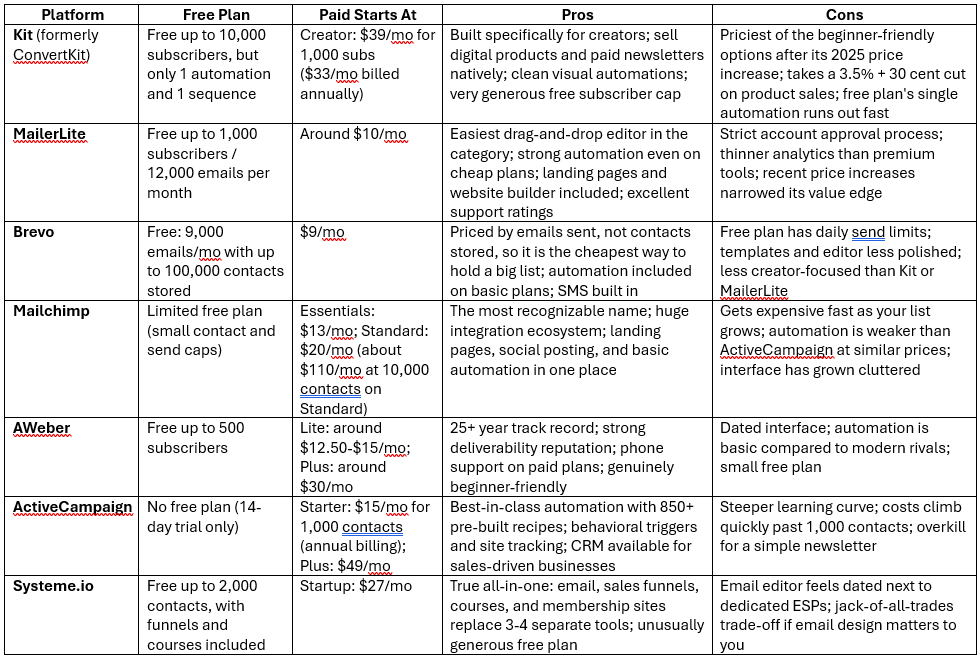
Lesson 2: Choosing Your Autoresponder (The Comparison Chart)
An autoresponder (also called an email service provider or ESP) is the tool that stores your list, sends your emails, and runs your automations. Do not overthink this choice. Every platform below can do the beginner-to-intermediate job. Pick based on budget and how you plan to grow.
Pricing verified July 2026. Prices are monthly billing at entry-level list sizes and change often, so confirm on each vendor's pricing page before you commit.
Choosing your best option (30-second version):
Just starting, zero budget, want simple: MailerLite or Brevo
Creator selling digital products or a paid newsletter: Kit
Want funnels + courses + email in one login: Systeme.io
Ready to invest in serious automation: ActiveCampaign
Want a long-established name with human phone support: AWeber
Action step: Pick one. Sign up for the free plan or trial today. You can migrate later; every platform on this list imports contacts from the others. The cost of choosing "wrong" is a Saturday afternoon. The cost of not choosing is months of lost list growth.
Lesson 3: Building Your List With a Lead Magnet
Nobody joins a list for "updates." They join for a specific, fast win. That is your lead magnet: a free resource exchanged for an email address.
The best beginner lead magnets share three traits:
Specific: "5 Subject Lines That Doubled My Open Rate" beats "Email Tips."
Fast to consume: A checklist or one-page template outperforms a 60-page ebook. Research on digital engagement consistently shows completion drives trust, and short resources get completed.
Connected to what you sell: If you sell a content planning product, your freebie should be about content planning, not a random recipe pack.
Formats ranked by effort-to-payoff for beginners:
Checklist or cheat sheet (1 page): lowest effort, high conversion
Template or swipe file: medium effort, very high perceived value
Short email course (5 days, delivered by your new autoresponder): medium effort, builds the open habit
Mini video training: higher effort, best for personality-driven brands
Where to put your opt-in form:
A dedicated landing page (every platform in Lesson 2 includes a builder)
The top and bottom of every blog post
Your social media bios, pointing to the landing page
Action step: Draft a one-page checklist or template this week. Give it a results-based title: what will the reader have or be able to do after using it?
Lesson 4: Writing Emails People Actually Open
Your subject line does 80% of the work. Your first line does the rest.
Subject line rules that hold up:
Under 50 characters where possible (mobile inboxes truncate longer ones)
Curiosity plus specificity: "The pricing mistake I made twice" beats "Newsletter #14"
Write 3-5 options, then pick; the first draft is rarely the winner
Avoid ALL CAPS, excessive punctuation, and spam-trigger words like "free money" or "act now," which can hurt deliverability
Body structure for a simple weekly email:
One-line hook that continues the subject line's promise
One idea, story, or tip (not three; one)
One call to action: reply, click, or buy
Writing to one reader in a conversational voice measurably outperforms corporate broadcast tone. Read your draft out loud; if you would not say it to a friend at coffee, rewrite it.
Deliverability basics (the unglamorous part that decides everything):
Send from a custom domain email (you@yourbrand.com), not a free Gmail address
Ask new subscribers to reply to your first email; replies signal inbox providers that you are wanted
Remove or re-engage subscribers who have not opened in 90+ days; a smaller engaged list beats a big dead one
Action step: Write your first welcome email: thank them, deliver the lead magnet, tell them what to expect and how often, and ask one easy question they can reply to.
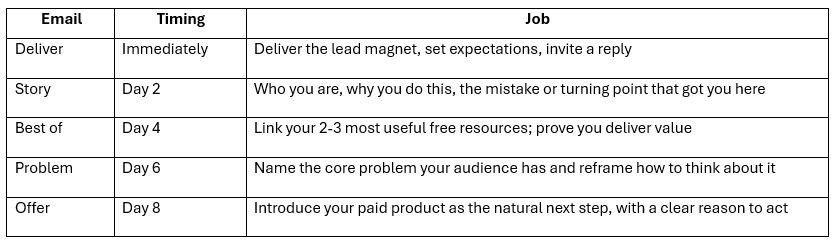
Lesson 5: Your First Automation (The Welcome Sequence)
An automation (or sequence) is a series of pre-written emails that send automatically on a schedule. The welcome sequence is the only automation a beginner needs, and it is where new subscribers are most attentive: open rates on welcome emails routinely run 2-4x higher than regular campaigns.
A simple 5-email welcome sequence:
Set it up once in your autoresponder from Lesson 2, and every new subscriber gets the full experience whether they join today or next year. This is the closest thing to passive selling that actually exists.
Action step: Outline all five emails in one sitting (bullet points only), then write one per day. Turn the sequence on before it feels "ready." You can edit live automations anytime.
Lesson 6: The Only Three Numbers That Matter (For Now)
Ignore vanity dashboards. Track these three, monthly:
Open rate: Percentage of recipients who open. Healthy small-list range is roughly 35-50% for engaged lists (Apple's privacy changes inflate opens somewhat, so treat this as a trend line, not gospel).
Click-through rate: Percentage who click a link. 2-5% is a solid beginner benchmark. This is your true engagement number.
List growth rate: New subscribers minus unsubscribes. If this is positive every month, you are winning. Unsubscribes are not failures; they are your list cleaning itself.
Your 30-day plan after finishing this course:
Week 1: Choose your platform (Lesson 2) and create your lead magnet (Lesson 3)
Week 2: Build your landing page and welcome email (Lessons 3-4)
Week 3: Write and activate your 5-email welcome sequence (Lesson 5)
Week 4: Send your first regular email, then commit to a sustainable rhythm (weekly beats daily-then-nothing)
Recommended Reading
Disclosure: The book links below are affiliate links. If you purchase through them, I may earn a small commission at no extra cost to you. I only recommend resources I believe are genuinely useful.
300 Email Marketing Tips by Meera Kothand: short, practical, written exactly for the solo marketer.
Email Marketing Rules by Chad S. White: the deeper reference for when you outgrow the basics, grounded in data rather than hype.
Newsletter Ninja by Tammi L. Labrecque: the best walkthrough of building a list readers actually love, especially for authors and content creators.
The Invisible Selling Machine by Ryan Deiss: a classic on turning sequences into a sales system, useful once your welcome sequence is running.
Huge Profits with a Tiny List by Connie Ragen Green: a guide to profiting with email, even with a small list
Go Further With These Tools
Ready to plug email into a bigger content and sales system? These are my own products, built for creators and online entrepreneurs at exactly this stage:
DFY Sales Funnel Template: Skip the blank page. A done-for-you funnel you can pair with the welcome sequence from Lesson 5.
90 Day Content Planner: Never wonder what to email about again. Plan a quarter of content, then repurpose it into your weekly emails.
CORE Micro Course: The bigger-picture system this micro course fits into.
Instant Infographics: Turn your lead magnet from Lesson 3 into something people actually want to download and share.
Pricing and platform details in this course were verified in July 2026 and will change. Always confirm current pricing on each vendor's official site before purchasing.